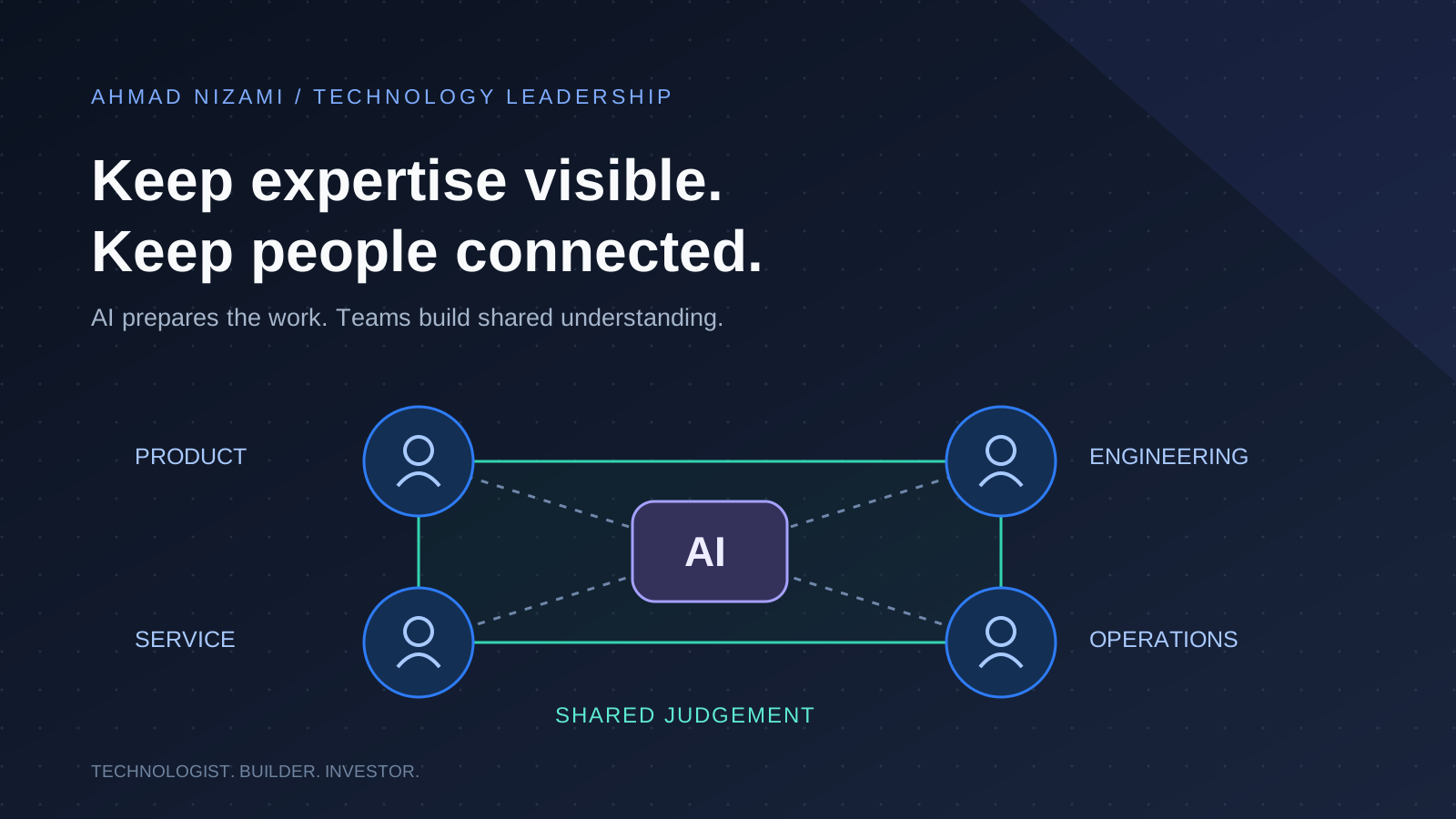
AI and team knowledge sharing need to be designed together. Giving each employee a capable assistant can reduce time spent finding an answer, while leaving colleagues less able to see how decisions were reached or who understands the problem.
This is not an argument for asking a colleague every question. It is an argument for distinguishing private preparation from work that changes the team's shared understanding.
In brief: Measure whether the team can still find expertise, challenge assumptions and coordinate decisions, not only whether individuals work faster. Recent HBR research highlights risks when AI replaces colleague interaction. Contrasting survey evidence suggests frequent AI use can also accompany stronger collaboration. The operating model matters more than a simple “AI helps” or “AI harms” conclusion.
The Agentic AI reading path covers the technical and organisational disciplines around agents. This article focuses on the human knowledge network that remains necessary when assistants and agents handle more individual tasks.
What the latest research does and does not show
On 15 October 2026, Harvard Business Review published research on AI and team dynamics by Kate Niederhoffer, Kristina Rapuano, Alex Liebscher, Alexi Robichaux and Jeffrey T. Hancock.
The authors report a survey of 1,033 US full-time desk workers on project teams across more than 20 industries. They distinguish using AI from preferring it as a replacement for a teammate. Reported displacement of colleague interaction was associated with weaker trust and coordination, even while AI use was associated with perceptions of greater specialist knowledge.
These are survey-based associations. They do not establish that deploying a particular tool causes a fixed deterioration in every team. Nor should the findings be converted into a forecast for your organisation.
There is useful contrasting evidence. In a 13 October release about its WorkLife 2026 report, Jabra reports that frequent AI users were more likely to say they collaborated more and felt more connected. Its vendor-sponsored survey was conducted by Toluna in May among more than 6,000 knowledge workers across six markets.
The studies do not measure exactly the same behaviour or population. Frequent use and deliberately replacing a colleague are different things. Neither survey proves causation. Their combined value is to sharpen the question: what kind of interaction is your rollout encouraging?
An answer and a shared understanding are different outputs
Imagine an illustrative SaaS support team handling an unusual customer request.
An adviser asks AI for an explanation and receives a plausible answer. The immediate task moves forward. But the colleague who understands the integration is never consulted, a subtle product limitation is missed and the team does not learn that this request is becoming common.
In another version, the adviser uses AI to organise the facts and identify uncertainties, then brings a concise question to that specialist. The resulting decision is captured in the approved case record and, where appropriate, improves the shared guidance.
Both versions use AI. Only the second deliberately maintains the team's knowledge network.
The distinction applies to engineering and leadership too. A private analysis may produce a polished recommendation without exposing the assumptions that another function would challenge.
The useful output is not always another document. Sometimes it is agreement about an exception, awareness of a changing risk or recognition that the apparent expert needs help.
Keep a usable map of who knows what
HBR's article draws on the idea of transactive memory: teams coordinate partly because members know where expertise sits and when to rely on one another.
An AI-generated answer can obscure that map if people cannot distinguish the author's judgement from a fluent draft. The remedy is not to demand a transcript of every prompt. It is to keep expertise and decision ownership visible.
For important work, identify who validated the conclusion, which sources matter and which questions remain open. A colleague should be able to find the person responsible without reconstructing a private chat history.
Maintain a lightweight expertise map around actual tasks. Who understands a particular integration failure? Who can interpret a policy exception? Who owns the commercial trade-off?
Review it when responsibilities change. Do not confuse a static skills directory with evidence of current capability.
This complements AI agent knowledge readiness, but addresses a different problem. Retrieval architecture helps an agent find reliable material. Team knowledge sharing helps people understand, challenge and improve the decisions around that material.
Decide which interactions AI should replace
Some exchanges are repetitive and transactional. A well-maintained answer about an approved process may save both the questioner and the specialist time.
Other exchanges do more than transfer information. They reveal uncertainty, help a newer colleague learn, expose disagreement or connect a customer's problem to a product decision.
Classify interactions by purpose rather than by communication channel. A brief message can carry an important warning. A long meeting can be unnecessary.
For one workflow, distinguish:
- Routine retrieval that can be handled from an approved source.
- Preparation that AI can help structure before a conversation.
- Decisions requiring another person's expertise or authority.
- Learning and relationship-building that should remain deliberate.
Define triggers for moving from AI assistance to a colleague. Conflicting evidence, a novel exception, an irreversible commitment or a question about another team's priorities are good candidates.
Do not make escalation feel like a failure to adopt AI. If staff are rewarded only for handling work alone, the organisation is encouraging them to hide the uncertainty it most needs to see.
Make consequential work visible without exposing everything
On 14 October, UC Today reported on Atlassian's approach to bringing agents into shared workflows. The coverage describes the company's Agentic Multiplayer Protocol strategy around shared context, visible ownership and reviewable activity.
This is a vendor direction reported by a technology publication, not proof that a collaboration platform improves trust or learning. Some capabilities may have different availability or depend on the customer's setup.
The architectural direction is nevertheless worth considering. Work that affects the team should leave an appropriate record in the place where the team makes decisions.
For a consequential recommendation, record the objective, material evidence, decision owner, unresolved assumptions and action agreed. Link to the relevant task or case. Keep the record short enough that someone can actually use it.
Do not automatically publish every AI conversation. Private preparation can contain personal information, customer data or unfinished thinking. Apply access controls and minimise what is retained.
Transparency should support coordination, not become surveillance. People need to know what decision was made and why, not have every exploratory sentence turned into a performance metric.
The coordination-layer article explores the cross-functional workflow architecture. This is its human counterpart: preserve enough context for colleagues to contribute rather than merely receive an automated result.
Protect useful challenge and apprenticeship
AI can help a junior employee prepare a stronger first attempt. It can also let them avoid the interaction through which a senior colleague would discover a misunderstanding.
Keep selected walkthroughs where the employee explains their reasoning, uncertainty and evidence. The goal is not to catch them using AI. It is to establish what they understand and what support they need.
A useful review question is: what would make this recommendation wrong? Another is: whose knowledge could change the decision?
Protect the senior person's time by asking AI to organise the background first. Then use the conversation for judgement, not for reading aloud what everyone already has.
For experienced staff, preserve disagreement across functions. A model cannot legitimately decide that an engineering constraint outweighs a customer promise just because it can write a confident comparison.
In customer operations, this may mean scheduled reviews of unusual cases rather than asking every adviser to interrupt a specialist on demand. For a distributed engineering team, it may mean a short design discussion before an agent generates a large implementation.
The right ritual depends on the work. More meetings are not the objective. Better access to judgement is.
Measure team capability, not collaboration theatre
Start by asking whether people can find the right expert, understand a recent decision and raise a concern without unnecessary friction.
Use short interviews and samples of real work alongside any survey. A rising message count could mean healthy collaboration or an increasingly confusing process.
Look for operational symptoms: repeated questions that never improve shared guidance, duplicated investigations, decisions reopened because another team was not involved, or new starters unable to identify who can help.
Track whether recurring exceptions become shared learning. If every adviser solves the same unusual case privately, individual speed may conceal a product or policy problem.
Avoid attributing every change to AI. Staffing, workload, management changes and remote-working patterns can affect the same outcomes. Keep comparisons bounded and document other material changes.
The Omningage case study provides a product context for joined-up customer work. It is not a claim that its teams have demonstrated the particular collaboration outcomes described here.
Run a four-week team experiment
Choose one team and one recurring workflow. Establish how expertise is found, where decisions are recorded and which interactions people consider useful.
Agree where AI can replace routine retrieval and where it should prepare the ground for a human exchange. Set explicit triggers for peer input.
During the experiment, review a small sample of consequential decisions. Can another team member explain the reasoning and find the owner? Did the right specialist see the exception? Did the result improve shared guidance?
At the end, discuss what became faster and what became harder to coordinate. Retain useful practices and remove rituals that add work without improving understanding.
This is part of technology transformation and delivery, not a separate culture exercise to postpone until after rollout. The technical design, incentives and everyday management practices shape one another.
For a rollout that needs both workflow implementation and clear operating ownership, discuss the delivery scope.
The strongest AI-enabled team is not the one that asks colleagues the fewest questions. It is the one that uses automation to make the right human conversations more informed, timely and useful.
Sources and evidence notes
- HBR, Team Dynamics Weaken When Employees Turn to AI Instead of Colleagues, Kate Niederhoffer, Kristina Rapuano, Alex Liebscher, Alexi Robichaux and Jeffrey T. Hancock, 15 October 2026. Survey-based management analysis. Associations are not presented as causal estimates; the article is summarised, not reproduced.
- Jabra WorkLife 2026 announcement, 13 October 2026. Vendor-sponsored survey conducted by Toluna in May 2026. Self-reported collaboration and AI-use frequency are not equivalent to HBR's colleague-displacement measure.
- UC Today, How Atlassian's AMP Brings AI Agents Into Team Workflows, Sophie Wilson, 14 October 2026. Technology reporting and analysis of vendor announcements, not an independent test of team outcomes.
Sources checked on 19 October 2026. The workflow examples and four-week experiment are original recommendations, not reported experiences or measured results from Ahmad Nizami's businesses.