An enterprise AI agent can retrieve the right document and still make the wrong decision.
The document might describe an old product, apply to a different customer tier or conflict with an exception recorded in a contract. Retrieval has succeeded. The business outcome has not.
AI agent knowledge readiness is therefore a different problem from giving a model access to more files. It means making the meaning, authority and limits of information usable at the point of a decision.
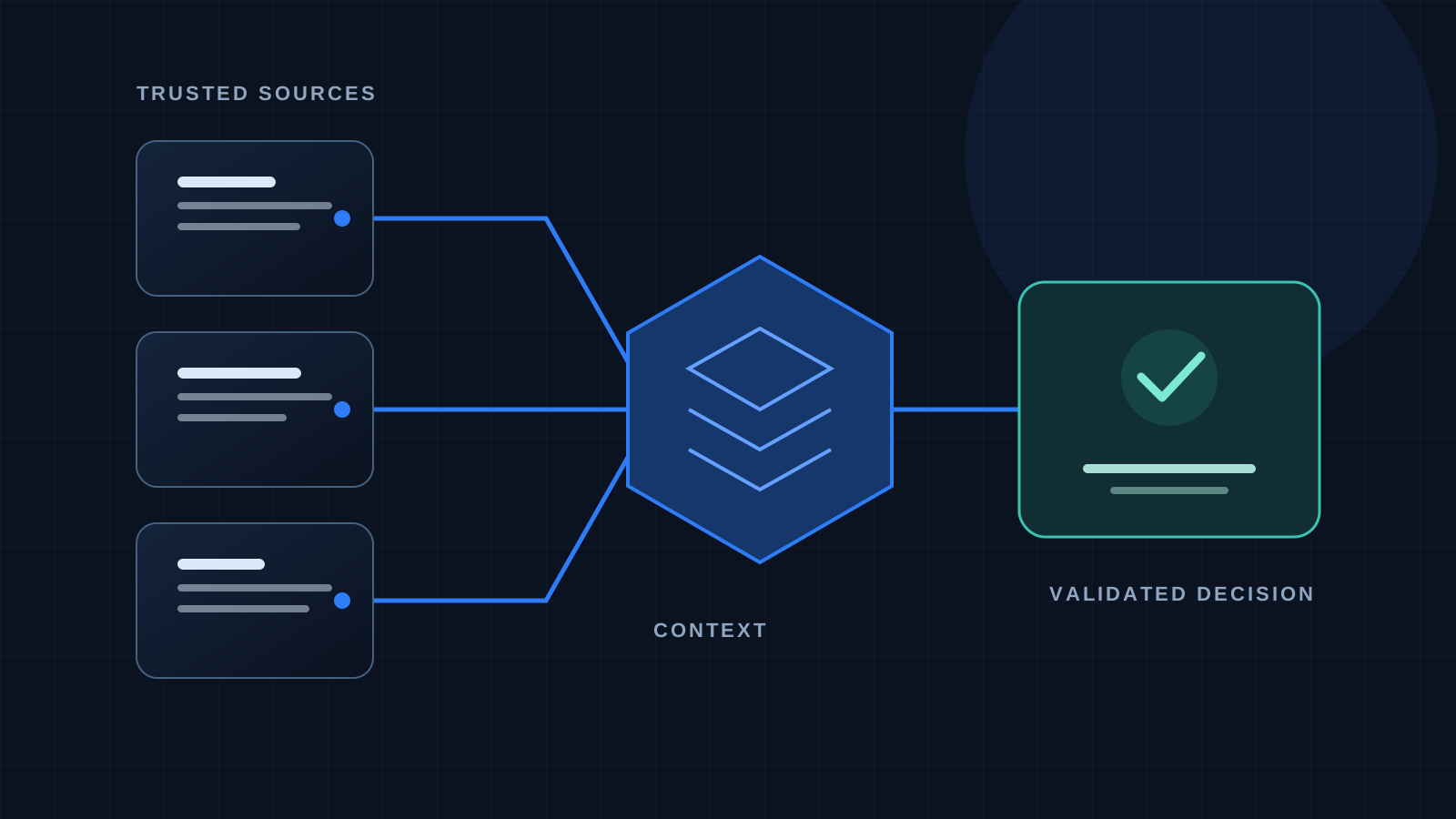
In brief: before extending an agent's autonomy, establish which sources it should trust, what business concepts mean, how conflicting evidence is resolved and when a person must validate the answer. More context is useful only when it is relevant, current and permitted.
This is a narrower engineering problem within the Agentic AI reading path. It complements workflow coordination and the control plane for agent authority, but it should not be confused with either.
The current signal: knowledge is becoming a product capability
Two recent developments make this worth examining.
On 30 September, InfoWorld reported changes to Stack Overflow's Stack Internal. The company describes capabilities that assess knowledge using provenance, recency, expertise, corroboration and human validation. It also describes routes to subject-matter experts and ways to identify conflicting information.
Those are product claims reported by a publication, not independent proof that a trust score guarantees correctness. Nevertheless, they show a useful shift in the tooling market: enterprise knowledge is being treated as something that needs validation and ownership, not simply ingestion.
On 5 October, MIT Technology Review Insights published a report introduction on enterprise knowledge and AI agents. The research, conducted in partnership with Neo4j, surveyed 300 data, AI and other technology executives. It distinguishes semantic knowledge, episodic memory and procedural knowledge, and reports an association between stronger knowledge capabilities and more projects reaching production.
This is sponsored research from the publication's custom-content arm, not its independent editorial staff. The reported relationship is not evidence that buying a knowledge graph causes successful deployment. It is a reason to investigate the knowledge bottleneck in your own workflow.
My practical conclusion is simpler than either a platform purchase or a wholesale data transformation: agents need a way to distinguish an available statement from an authoritative statement that applies here.
A support example: correct information, wrong scope
Consider an illustrative customer-service workflow.
A customer asks whether a service credit is available after an outage. The agent retrieves a policy saying credits apply after four hours of downtime. It also finds an internal note saying enterprise customers have a different threshold.
The customer's contract contains an amendment. The incident record distinguishes partial degradation from complete unavailability. An account note says the customer moved to a new service tier last month.
Every source may be accurate in isolation. The decision depends on their relationships.
The agent needs to establish the relevant contract, the effective date, the incident classification and the policy's scope. It also needs to know whether it may calculate a recommendation or actually issue a credit.
This is why customer context matters in customer-experience technology. Joining records is only part of the job. Joining their meaning is what makes the result useful.
The example is a design scenario, not a claim about a deployed product. It illustrates why an agent can produce a plausible answer while missing the commercial rule that matters.
Start with a knowledge contract for one decision
I would begin with one decision the agent is expected to support, not an instruction to ingest the whole company.
Write a short knowledge contract. It should define:
- the business concepts required for the decision;
- the authoritative source for each concept;
- the time and customer scope in which the information applies;
- the relationships needed to interpret it;
- the evidence that must accompany the recommendation;
- the conditions requiring validation or escalation.
For the service-credit example, the concepts might include entitlement, incident severity, contract version and account status. The contract should specify who owns each definition and how an agent handles missing or contradictory evidence.
A retrieval system can then be judged against that contract. Did it return information that was merely related to the question, or did it retrieve the evidence needed for this decision?
That distinction makes the problem testable. It also gives the business owner something more concrete to review than the quality of a generated paragraph.
Separate meaning, memory and procedure
When procedures become reusable packages, they need their own release discipline. The guide to Agent Skills in production covers provenance, pinned versions, runtime compatibility and controlled promotion.
The three knowledge categories used in the sponsored MIT Technology Review Insights research provide a helpful design vocabulary.
Meaning covers the terms and relationships in the business. What counts as an active customer? Does “resolved” mean a ticket was closed or that the customer confirmed the outcome? Which product name maps to which entitlement?
Memory covers relevant history. What happened earlier in this case? Which exception was approved, by whom, and for how long? A previous decision should not automatically become permanent policy.
Procedure covers the permitted route from evidence to action. Which checks precede a recommendation? Which approval is required? What happens if a source is unavailable?
These are different responsibilities. A document search index may help with all three, but it does not establish their authority by itself.
Keep historical observations separate from current rules. Otherwise, a one-off concession can become the agent's default recommendation. Equally, avoid treating a policy document as a complete description of how work is actually performed.
Choose architecture after identifying the missing relationship
A knowledge graph can be useful when the important problem is relationships: customer to contract, contract to amendment, product to entitlement, or incident to affected service.
It is not mandatory for every agent.
A well-maintained relational model, a small semantic layer, governed APIs and a curated document collection may be sufficient for a bounded workflow. Retrieval-augmented generation can supply relevant passages, but the application still needs rules for scope, permissions and conflicting evidence.
The architecture decision should follow the question the system cannot answer reliably.
If the agent cannot identify the current policy version, fix versioning and source ownership. If it cannot connect a customer to the right agreement, fix entity resolution. If it retrieves an answer from a restricted source, fix access enforcement. None of these problems is solved merely by increasing the context window.
Conversely, accurate context does not eliminate model error. Grounding reduces one source of uncertainty. It does not remove the need for evaluation, constrained actions and human oversight.
Give knowledge an owner and a review cycle
The expensive part of enterprise knowledge is often maintenance.
A policy changes. A product is retired. An exception expires. A team reorganises. If the agent's evidence has no owner, nobody is responsible for noticing that it no longer applies.
For each important source, record its owner, effective date, review date and replacement rule. The agent should be able to recognise withdrawn material rather than treating the most frequently retrieved document as the most trustworthy one.
A numerical trust score can help route attention, but it should not become a substitute for evidence. A recently edited document can still be wrong. A highly corroborated statement can reflect several copies of the same original error.
Where sources conflict, preserve the disagreement and route it to the right person. Do not ask the model to reconcile a contractual conflict through confident prose.
The same discipline matters in an omnichannel agent workspace. A joined-up customer view is valuable only if an operator can understand where its information came from. The Omningage platform overview provides the related product context.
Build calibrated trust, not a more reassuring interface
HBR's September article on employee trust in AI agents identifies uncertainty about reliability and safe action as a barrier to adoption. Its public summary emphasises making capabilities and limitations explicit.
Knowledge design can make those boundaries visible.
An agent should distinguish “the policy permits this” from “a previous case suggests this may be possible”. It should show the applicable source and date, explain missing evidence and make validation straightforward.
That is more useful than a reassuring confidence label. Employees need to know when reliance is justified and when checking is necessary.
Measure the result through decision quality: use of applicable sources, detection of conflicting policies, correct escalation, correction rates and the time people spend validating recommendations. A larger document collection is not a business outcome.
A practical starting plan
Before expanding autonomy:
- Select one recurring decision and define the evidence needed to make it correctly.
- Assign authoritative sources, owners, scope and effective dates to its key concepts.
- Test stale policies, conflicting records, missing relationships and restricted information.
- Add a human-validation route that updates the underlying knowledge, not just the current answer.
- Measure correct decisions and validation effort before adding sources or buying another platform.
For leaders planning technology transformation and delivery, this is an achievable first increment. If the knowledge contract exposes uncertainty, that is useful evidence for the delivery plan, not a reason to hide it behind a more capable model. A focused architecture discussion should start with that decision and its evidence.
The next agent may not need more autonomy. It may need a clearer understanding of which facts are allowed to become a business decision.
Sources and evidence notes
- Stack Overflow expands Stack Internal to give AI agents ‘trusted’ enterprise knowledge, Anirban Ghoshal, InfoWorld, 30 September 2026. Product capabilities are attributed to the company; this is not an independent effectiveness evaluation.
- Connecting AI agents to enterprise knowledge, MIT Technology Review Insights, 5 October 2026. Sponsored research in partnership with Neo4j; survey associations should not be interpreted as causation.
- To Adopt AI at Scale, Employees Need to Trust Agents, Thomas McKinlay, Stefano Puntoni and Serkan Saka, Harvard Business Review, 9 September 2026. Summarised and linked, not reproduced.