AI agents are often introduced as a better kind of assistant: a faster way to search, draft, summarise or answer.
That is useful, but I do not think it represents the biggest opportunity.
The more significant change is coordination.
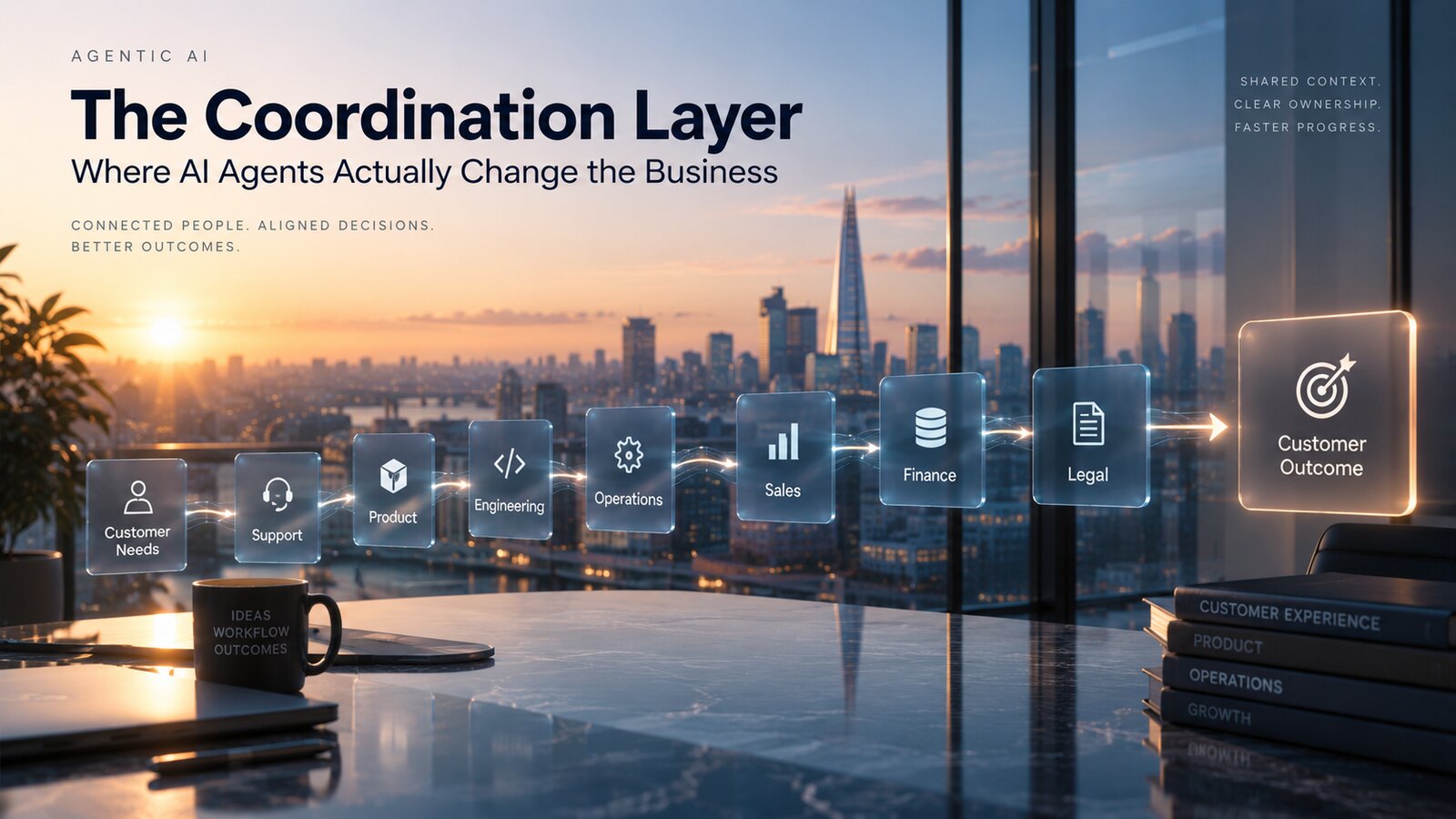
Most difficult business outcomes are not contained inside one task, application or department. A customer issue may begin in support, require a product decision, involve engineering, create a commercial exception and eventually need finance or legal approval.
Every team involved can perform its individual task correctly and the customer can still experience delay, repetition and contradiction.
The problem is often not execution inside the boxes on an organisational chart.
It is what happens between the boxes.
This is where Agentic AI becomes interesting.
An agentic system can carry context and commitments across organisational boundaries. It can understand the desired outcome, identify which decisions are required, involve the right people or systems, monitor whether actions have happened and surface the consequences when they have not.
That is more than task automation.
It begins to look like a new coordination layer for the operating model.
This article sits within my wider Agentic AI reading path, which connects workflow design to orchestration, trusted autonomy and governance.
There is an important qualification, however.
Software cannot make an unclear organisation clear.
If nobody knows who may approve a refund, change a service level, accept a technical risk or make a commercial exception, adding an AI agent will not solve the problem. It may simply move the ambiguity faster.
The work therefore does not begin with:
"Where can we add an agent?"
It begins with:
"How should this outcome actually move through the organisation?"
The Work Between the Boxes
Harvard Business Review's discussion of AI agents and cross-functional work describes a familiar organisational problem.
A strategic intent can move through procurement, logistics, finance, legal, marketing and sales, with each function interpreting the requirement according to its own priorities and constraints.
By the time execution happens, the result may be a collection of individually reasonable decisions that no longer produces the intended outcome.
The same pattern appears constantly in customer experience.
Imagine a customer requesting an important capability.
Support records it.
Product assesses priority.
Engineering considers complexity.
Security reviews risk.
Sales discusses expectations with the customer.
Finance evaluates any commercial effect.
None of those activities is necessarily difficult in isolation.
The problem is maintaining a consistent outcome, context and set of commitments across the entire journey.
Information decays at hand-offs.
Assumptions change.
Decisions wait in inboxes.
Two teams work from different versions of the truth.
A customer eventually becomes the person coordinating the supplier.
That is a workflow problem, not a chatbot problem.
An Agentic AI coordination layer becomes valuable when it makes those hand-offs explicit.
It should understand:
- the outcome the organisation is trying to achieve;
- which facts are trusted and when they were last verified;
- which function owns each decision;
- which decisions are still unresolved;
- which actions can happen in parallel;
- which actions depend on another decision;
- when human approval is required; and
- what evidence demonstrates that the outcome has actually been achieved.
This gives us a much better unit of value for Agentic AI.
Not prompts.
Not summaries.
Not the number of agent interactions.
Completed business outcomes.
Agentic Does Not Mean Unsupervised
The OECD's analysis makes a useful distinction between an AI agent and the broader concept of Agentic AI.
An agent can perceive its environment and take actions with some degree of autonomy towards a goal.
Agentic systems become more interesting when work is decomposed, delegated and coordinated across agents, systems and people over time.
That does not mean every business process needs a team of autonomous agents.
A stable and well-understood process may be better implemented as conventional software with clear rules.
A process containing several specialist decisions may benefit from an orchestrator that involves different agents or people. The AI agent orchestration platform comparison explores the production infrastructure that can support this work.
The architecture should follow the shape of the work.
Not the fashion of the market.
A useful starting point is a relatively simple coordination loop.
1. Observe
Gather the customer, operational, product and business context required for the outcome.
2. Interpret
Identify the objective, constraints, outstanding questions and conflicting information.
3. Plan
Break the desired outcome into decisions and actions.
4. Coordinate
Send each decision or action to the appropriate person, system or specialist agent.
5. Escalate
Stop when authority, confidence, evidence or risk falls outside the permitted boundary.
6. Learn
Capture what happened, where the process failed and what evidence should improve the next cycle.
The loop still requires accountable ownership.
An AI agent may coordinate work and prepare recommendations, but a business needs to know who is ultimately responsible for the outcome.
"The system decided" is not an operating model.
Redesign Decision Rights Before Prompts
One of the most useful artefacts in an Agentic AI programme may have nothing to do with prompt engineering.
It is a decision-rights map.
For every significant step in a workflow, identify:
- the decision being made;
- the accountable owner;
- the evidence required;
- the action that is permitted;
- the limit of that authority;
- the threshold for escalation; and
- the expected response time.
Consider a customer-resolution workflow.
An agent might be allowed to issue a small goodwill credit under clearly defined circumstances.
A larger credit might require a team leader.
A contract amendment may require a commercial owner.
A product commitment may require product and engineering approval.
The value of documenting this is not simply risk reduction.
It exposes organisational ambiguity that previously lived inside email, meetings and individual judgement.
It also makes the agent measurable.
Instead of asking whether the model produced persuasive text, you can ask:
Did the system identify the correct decision, obtain the right evidence and route it to the person with the correct authority?
That is a far more useful test.
Context Needs Architecture Too
Coordination does not mean copying every available piece of data into every interaction.
An agent should receive the minimum trusted context required for the next decision.
That context should have provenance.
Where did this information come from?
When was it last updated?
Is it authoritative?
What should happen when two systems disagree?
Giving an agent more context is not automatically better.
Large amounts of poorly governed context can simply produce more confident confusion.
For a decision-level implementation approach, see AI agent knowledge readiness, which covers source authority, scope, freshness and validation.
Where Should Organisations Begin?
The best early Agentic AI projects are not necessarily the biggest.
Look for workflows with four characteristics.
They Cross Functions
A process involving several organisational hand-offs offers more coordination value than a task already performed efficiently inside one team.
The Outcome Is Observable
You should be able to measure something meaningful such as:
- time to resolution;
- approval latency;
- rework;
- customer effort;
- repeat contact;
- revenue protected; or
- cost per completed outcome.
The Authority Boundary Is Explainable
The first version should know precisely what it may do and where it must stop.
The Workflow Repeats
A recurring workflow provides the feedback required to improve the system safely.
A customer escalation is a good example.
An agent could assemble the history, identify the underlying issue, determine which teams need to become involved, create an action plan and monitor commitments.
It should not silently promise a product change, alter a commercial agreement or approve an exception outside its authority.
Those decisions remain visible and assigned.
Do Not Start by Building a Generic Agent Platform
There is a temptation, particularly for technology teams, to begin by creating a generic enterprise "agent platform".
I would resist that initially.
Build one useful coordination loop first.
Understand:
- its events;
- its data;
- its decisions;
- its permissions;
- its hand-offs;
- its failure states;
- its human interventions; and
- its measures of success.
Then identify which capabilities genuinely deserve to become reusable platform components.
Architecture should emerge from real workflows, not from an abstract desire to build infrastructure.
Agentic AI Changes the Operating Model Too
The technology is only one part of the change.
Gartner's 2026 discussion of the Agentic AI landscape highlights an ecosystem with very different levels of maturity. Its survey data showed relatively limited current deployment alongside much greater stated adoption intent.
That difference matters.
Ambition does not equal organisational readiness.
Operating Agentic AI at scale requires capabilities around development, orchestration, permissions, context, evaluation, observability and lifecycle management.
But it also creates a new management rhythm.
Product, operations, security and customer-facing teams should review the workflow itself.
Where are decisions being delayed?
Where are humans regularly overriding the system?
Which exceptions are increasing?
Which hand-offs still lose information?
Which decisions create most of the rework?
An override is not automatically evidence that an AI agent has failed.
It may show that the system correctly recognised the boundary of its authority.
Or it may expose a business process that has changed.
Both are useful information.
Measure Outcomes, Not Agent Activity
Useful measures for an Agentic AI coordination workflow include:
- elapsed time from customer signal to resolved outcome;
- percentage of hand-offs containing complete context;
- first-time-right decision rate;
- approval and escalation latency;
- rework caused by incomplete or conflicting information;
- customer effort;
- repeat contact; and
- total cost per completed outcome, including human involvement.
Do not treat the number of agent actions as a measure of success.
More agent activity can simply mean a more complicated process.
The question is much simpler:
Did the organisation reach a better outcome with less avoidable friction, while maintaining clear accountability?
A Practical Starting Checklist
- Choose one recurring business outcome that crosses multiple functions.
- Measure how that workflow performs today before introducing AI.
- Map every significant decision, owner, permission, escalation threshold and evidence requirement.
- Design the smallest coordination loop capable of improving part of the outcome safely.
- Give the system trusted, purpose-limited context rather than unrestricted information access.
- Keep consequential decisions visible and accountable.
- Review exceptions, delays and human overrides regularly.
- Improve the workflow before increasing the level of autonomy.
The next generation of enterprise AI will not be defined by which organisation deploys the most assistants.
It will be defined by which organisations become better at moving decisions, context and accountability across the boundaries that previously made good execution slow.
That is where I believe AI agents will begin to change the business.
For a closer examination of authority boundaries, continue with From Workflow to Trusted Autonomy. If you are redesigning an enterprise workflow, get in touch to discuss the architecture.
Sources
- How AI Agents Orchestrate Work Across Silos - Kris Johnson Ferreira and Jordan Tong, Harvard Business Review, September-October 2026. Summarised, not reproduced.
- The Agentic AI Landscape and Its Conceptual Foundations - OECD, February 2026.
- What the 2026 Gartner Hype Cycle for Agentic AI Reveals - Rajesh Kandaswamy, Gartner, April 2026.
- The Strongest Teams of AI Agents Will Be Built Using Different Models - Mark Purdy, Harvard Business Review, June 2026. Summarised, not reproduced.