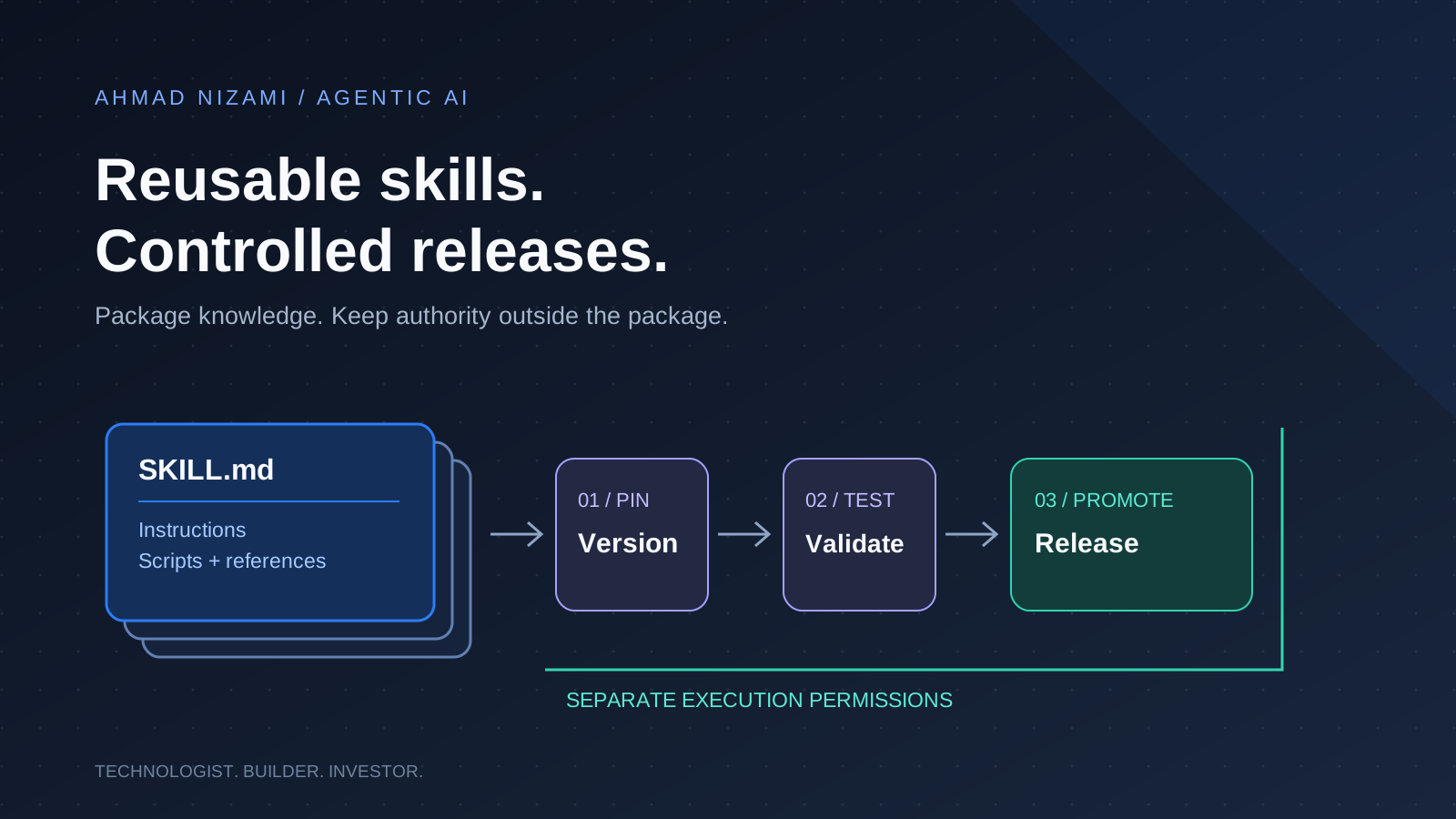
Agent Skills make specialist procedures easier to package and reuse. That is valuable for enterprise teams that do not want every agent to rediscover how a support case, report or operational investigation should work.
But a reusable instruction package is also a dependency. It can change what an agent reads, which tools it selects and what work it attempts. If those instructions are updated outside the normal release process, production behaviour can change without a conventional application-code deployment.
In brief: Treat Agent Skills as versioned production inputs, not informal prompt snippets. Check their origin, review bundled scripts, test their behaviour in the intended runtime and keep permission enforcement outside the instructions. A portable format can reduce packaging effort without making execution automatically safe or identical across platforms.
This article addresses the change-management question within the Agentic AI topic hub. It does not replace the broader Agentic AI control-plane architecture. Its focus is the lifecycle of the reusable package that influences an agent.
Why this is timely
On 6 October 2026, IBM announced a private preview of a skill-based redesign of watsonx Assistant for Z. The announcement describes a design using the Agent Skills standard, with plans for multi-step reasoning, operational recommendations and user-approved actions.
The status matters. This is a selected-client private preview and a vendor statement of direction, not evidence of generally available functionality or independently measured production benefits. IBM explicitly says that future direction may change.
Nevertheless, the announcement is a relevant signal. Reusable skills are being considered for complex enterprise operations, not only personal assistant tasks. That raises a practical question for CTOs and operators: who owns the procedure when it becomes a package an agent can load?
The format is defined in the Agent Skills documentation. A skill is a directory containing a SKILL.md file with metadata and instructions. It may also contain executable scripts, reference documents and assets. The agent can discover a skill from its name and description, then load fuller instructions and resources when needed.
This structure is simple enough to make sharing attractive. It is also substantial enough to deserve a release process.
Separate packaging, behaviour and authority
Three different things are often collapsed into the word “skill”.
First is the package: instructions, metadata and resources in a recognised layout. Second is behaviour: what an agent actually does when it interprets that package in a particular environment. Third is authority: what actions that environment allows.
A valid package does not guarantee correct behaviour. Correct behaviour on one test does not establish permission to act in production.
The specification includes an optional allowed-tools field, but describes it as experimental and notes that support may vary between implementations. A team should not assume that a declaration inside the file creates an enforceable security boundary.
Runtime controls need to decide which identities may call which tools, with which parameters and approval conditions. Credentials, network access and write permissions should remain constrained independently of whether the model follows an instruction.
F5's April analysis of Agent Skills makes this distinction between instructions and execution controls. It is a security vendor's architectural argument, not an independent test of every implementation. The useful principle is narrower: a package asking for a capability must not be able to grant itself that capability.
Build an inventory before building a marketplace
An enterprise does not need a large internal skills catalogue to begin. It needs to know which packages can affect its agents.
For each production skill, record the source, owner, exact version or content hash, business purpose and approved environments. Include any scripts and external resources it relies on. State which systems it can affect through the runtime's permissions.
A useful inventory also records the process owner. The person maintaining a script may not be authorised to change the refund policy or incident-escalation procedure that the skill describes.
Distinguish between internally authored, vendor supplied and community supplied packages. The distinction is not a verdict on quality. It tells the team what evidence and review are needed before adoption.
Avoid silently loading “latest” from a remote source in production. Pin the reviewed package, including referenced resources where practical. If a reference document is expected to change independently, define how those updates become visible and when revalidation is required.
This is different from simply collecting more context. The guide to AI agent knowledge readiness covers authority and freshness of information. A skill adds a procedural layer: it may tell the agent what to do with that information.
Review the whole package
Reading SKILL.md is necessary but insufficient when the package contains code or further references.
Inspect scripts for network calls, filesystem writes, subprocess execution and dependency installation. Check whether a seemingly harmless reporting procedure can send data to an external endpoint or retrieve more instructions at runtime.
Review instructions for ambiguity and conflicts. Does “resolve the case” mean prepare a recommendation, update a record or contact a customer? What should happen if a prerequisite is missing? Which decision requires a person?
Then inspect how the skill is discovered. A broad description can make a specialist package activate in unrelated workflows. A narrowly described diagnostic skill should not become the default method for every incident.
Check licences and provenance as well. A convenient package may contain third-party material whose reuse terms are unclear. Copying it into an internal repository does not resolve that question.
The objective is not to turn every instruction edit into a heavyweight audit. It is to identify changes with operational consequences before they acquire production reach.
Make the procedure testable
A good production skill states inputs, expected outputs, prerequisites and stop conditions. These make both human review and automated checks easier.
For an illustrative customer-service skill, the input might be a case identifier and the current policy version. The output might be a proposed resolution with cited policy evidence. A missing account match, conflicting policy or unsupported action should lead to a defined stop, not an improvised answer.
Tests should include normal cases, incomplete context, contradictory evidence and attempts to push the package outside its scope. If the skill can invoke tools, test allowed and disallowed actions separately.
Keep a small set of representative cases under version control. Record the package version, agent runtime, model configuration, tool definitions and permissions used in each run. Otherwise a changed result cannot be attributed meaningfully.
Do not rely only on format validation. A correctly named folder and valid YAML do not establish that a procedure produces the right business outcome.
The production agent-evaluation guide supplies the broader release discipline. For a skill, apply it to the package and its actual execution environment rather than assuming that text portability implies behavioural equivalence.
Portability needs a compatibility contract
An open format can make instructions easier to share across compatible agents. It does not make every runtime identical.
Tools may have different names and argument schemas. Filesystem access may differ. One environment may ask for approval before a write while another lacks the same mechanism. Models may interpret the same instruction differently.
Maintain a compatibility record for each supported runtime. Specify required tools, expected resource locations, network assumptions and approval behaviour. Test the package in each environment that matters.
Keep organisation-specific details separate where possible. A reusable investigation procedure can call a well-defined internal tool instead of embedding one platform's credentials or undocumented endpoints.
If a package needs platform-specific instructions, make that explicit. Concealing the dependency to preserve an attractive claim of portability makes support harder.
For SaaS builders, this is also a product-design opportunity. Stable tool contracts and observable failures can matter more than a larger collection of prebuilt skills. Customers need to understand what is supported, what requires configuration and who maintains the integration.
Use a controlled promotion path
Treat a skill update as a change with a scope, reviewer and release decision.
Move from authoring to isolated tests, then to a limited environment with real operating constraints. Prefer read-only or recommendation-only execution first when the task permits it. Promote write-capable behaviour only after the relevant action boundaries have been checked.
A release record should identify the package, compatible runtime versions, test results, approving owner and rollback plan. The rollback plan needs to distinguish between restoring instructions and undoing completed actions.
Reverting a skill cannot unsend an email or automatically reverse a customer refund. For consequential tools, the business process needs separate recovery procedures and a record of actions already taken.
Define triggers for revalidation: a script change, altered policy reference, new tool permission, runtime upgrade or a newly supported task family. A wording correction may need lighter review than a change from recommending an action to executing it.
Monitor results after promotion. If escalations or unexpected tool calls rise, disable the affected capability while investigating rather than only rewriting the prompt and hoping it behaves differently.
Ownership is a management issue too
A procedure belongs to a business operation, even when engineers package it.
HBR's September article on middle managers and AI adoption argues that managers shape how technology becomes daily work. Applied here, a production skill needs an owner who can resolve ambiguous policy, approve changes and support the people receiving its output.
That does not mean managers should manually inspect every file. It means engineering and process ownership must connect. The technical reviewer checks execution; the operational owner checks whether the procedure is legitimate.
For customer-experience platforms such as Omningage, reusable procedures could touch joined-up customer context and service workflows. This is an illustrative application, not a claim that the product currently deploys this specific skills architecture.
The wider technology transformation and delivery approach should make these ownership decisions explicit before packages spread across teams.
Start with one bounded skill
Choose one repeatable procedure with an observable outcome. Define its boundaries and name its owner. Pin the package, inspect every resource and test it in the intended runtime.
Keep execution permissions outside the instructions. Release to a limited environment, observe outcomes and retain a known-good version. Expand only when the evidence supports another task or stronger authority.
The value of Agent Skills is reuse with less repeated setup. The mistake is treating that convenience as permission to skip dependency management.
If you are designing an enterprise agent rollout, discuss the operating and release model. Begin with the procedure, its dependencies and the actions it must never take without approval.
Sources and evidence notes
- IBM, Introducing skill-based Agentic AI for IBM Z: Private preview, 6 October 2026. Vendor announcement of a private preview and intended capabilities, not independent outcome evidence or general availability.
- Agent Skills overview and specification, checked 12 October 2026. Primary documentation for package structure, progressive loading and the experimental
allowed-toolsfield. - F5, Agent skills: An emerging open standard, Lori Mac Vittie, 6 April 2026. Vendor-authored security analysis. Its proposed architecture is not treated as a mandatory standard or independently verified product comparison.
- HBR, Middle Managers Will Make or Break AI Adoption, Gleb Tsipursky, 1 September 2026. Management argument summarised and cited, without reproducing paywalled text.
Sources checked on 12 October 2026. The release model, checklist and customer-service example are original recommendations, not claims of measured results from Ahmad Nizami's businesses.