AI customer feedback analysis can produce a persuasive priorities slide in minutes. It can group complaints, extract themes and describe what customers appear to want.
The difficult step is deciding whether those themes identify what customers actually value, and whether changing them will improve the business.
A frequently mentioned problem deserves investigation. It does not automatically deserve the largest product investment. Some customers never contact support. Some important requirements are so familiar that people mention them only when they fail. A vocal account can dominate the record without representing the market.
In brief: Use AI to organise feedback and make evidence easier to inspect. Keep theme frequency, customer importance and the effect of a proposed change separate. Prioritise through representative research and bounded outcome tests, not a polished summary alone.
This week's research challenges managerial confidence
In HBR's November-December article on customer value, Vikas Mittal, Alessandro Piazza, Sonam Singh and Ashwin Malshe describe a gap between executives' confidence in understanding customers and the priorities supported by customer research. The article was already accessible and included in HBR's 29 October roundup.
The useful lesson is not that leaders should ignore experience. It is that listening, collecting data and watching competitors do not themselves establish which factors drive customer value. The research spans multiple sectors; it is not a controlled evaluation of AI feedback software.
A second, narrower signal comes from TechCrunch's 30 October reporting on DoorDash. It reports management's statement that third-party agents had generated only several hundred orders, despite extensive industry attention to agent-led commerce.
That is a company comment reported by a publication, not an audited market-wide adoption estimate. It does not establish that agentic commerce will fail. It does show why attention to a technology and demonstrated customer behaviour must remain separate in a decision.
DoorDash's 29 October results release describes its own AI products alongside physical fulfilment investment. The release supplies primary context for the company's stated priorities, but does not independently substantiate the agent-order count in the news report.
For CX and SaaS leaders, the practical question is local: what evidence would justify moving one customer problem ahead of another?
Decide which decision the feedback should support
Do not begin with “summarise everything customers said”. Begin with the decision.
Are you choosing a renewal improvement, deciding which self-service journey to repair or assessing demand for a new interface? Each requires a different population, time horizon and outcome.
Write the decision in one sentence. For example: “Choose the next improvement to the subscription cancellation journey, protecting correct outcomes while reducing avoidable customer effort.”
Then identify what feedback can and cannot establish. Conversations may reveal confusing language and failed steps. Account records may show whether cancellation completed. Customer research may clarify which aspects matter when people choose or leave a service.
Keep urgent service recovery separate from strategic prioritisation. A serious individual complaint can require immediate action even when it does not justify redesigning the product for every customer.
This sits within the contact-centre AI reading path. It is not another method for scoring advisers. The quality-calibration article addresses whether a particular interaction was assessed correctly; this article asks what the accumulated evidence should change.
Give every theme a denominator
A theme count is hard to interpret without knowing how the underlying material was collected.
Record the source population, dates, channels, inclusion rules and exclusions. Distinguish customers, cases and interactions. One unresolved case may produce several calls, an email and a complaint, all of which an automated report could count separately.
Show both customer-level and interaction-level views when they answer different questions. Repeated contacts reveal operational effort. They should not silently become multiple independent votes for a product feature.
Inspect missing groups. Feedback from English-language chat users does not represent everyone using telephone support or accessibility assistance. Survey respondents may differ from non-respondents. Prospects who abandoned a sign-up form may never enter the service dataset.
Avoid collecting unnecessary sensitive attributes merely to improve a dashboard. Use proportionate, lawful segmentation and explain the limitations of what is available.
Where the denominator is unknown, say so. “Delivery uncertainty appears in the reviewed sample” is more defensible than “delivery uncertainty is customers' top priority”.
A smaller, well-described evidence set can support a better decision than a large collection whose boundaries are invisible.
Use AI as an evidence organiser
Give the analysis a controlled set of tasks: identify candidate themes, link them to supporting records, flag ambiguous cases and retain contrary examples.
Require traceability. A reviewer should be able to inspect why a case received a label without relying on an invented quotation or an uncheckable summary. Where privacy restrictions prevent sharing the source record, provide an authorised review path rather than copying it into every report.
Test a sample against the original material. Check whether the model has merged different problems under one label, split the same issue into several labels or inferred a requested solution that the customer never proposed.
An illustrative example is “make cancellation easier”. One customer means finding the page. Another means understanding the charge. A third successfully cancelled but still received an invoice. Combining these as a single interface problem sends the product team towards the wrong fix.
Keep the labelling scheme and model configuration versioned where possible. If the categories change halfway through a trend chart, an apparent increase may be an analytical change rather than a customer change.
The AI knowledge-readiness guide covers source authority and meaning more broadly. Here the immediate requirement is a defensible path from theme to evidence.
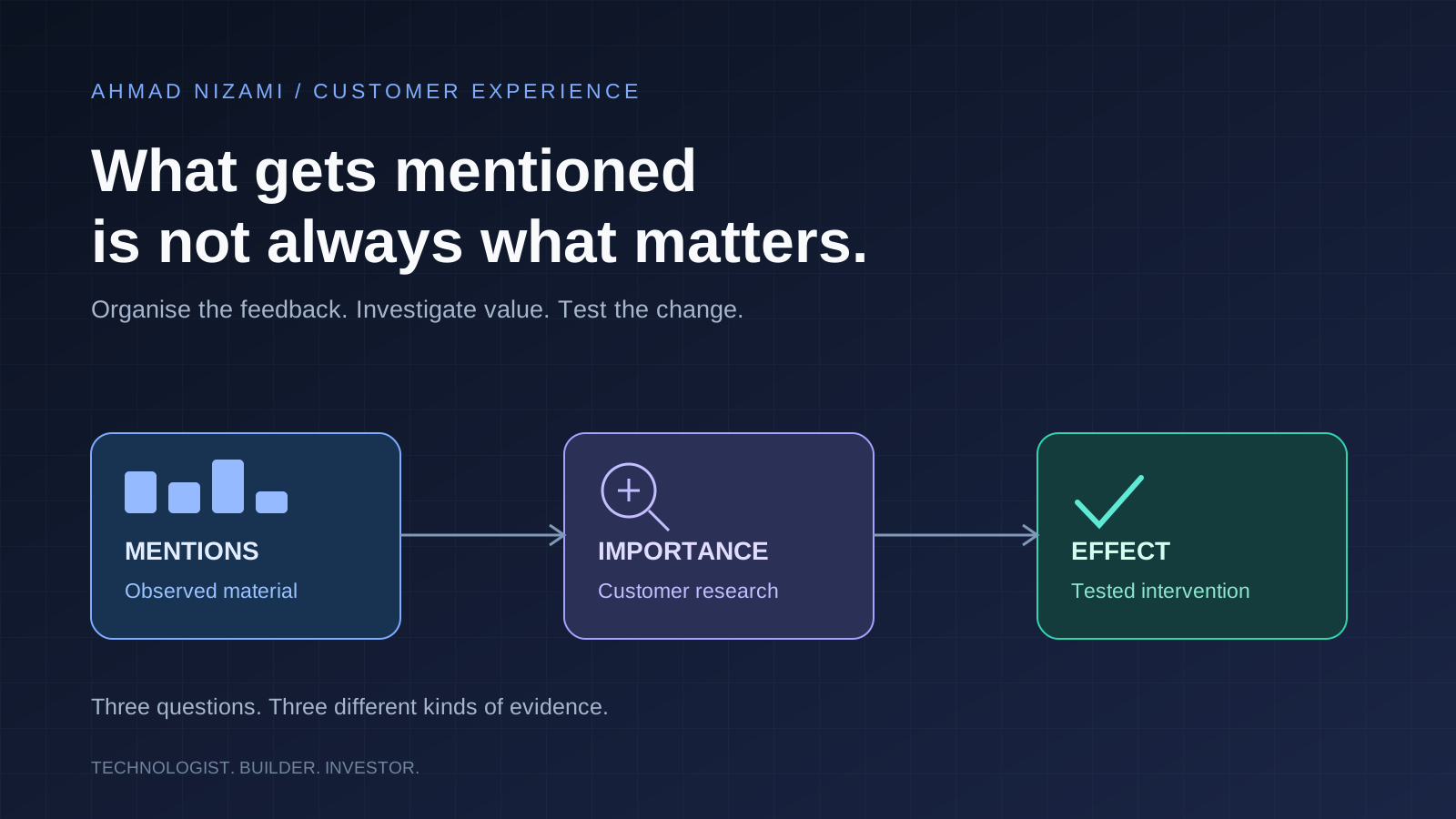
Separate volume, importance and effect
Three statements that sound similar require different evidence.
Volume: customers in the reviewed dataset mentioned a topic frequently. This describes the observed material.
Importance: a factor influences how a relevant customer group values or chooses the service. This requires customer research suited to the question, not only counts of mentions.
Effect: changing a factor improves a specified outcome. This requires a credible comparison or intervention, with uncertainty stated.
Consider a hypothetical SaaS operation receiving many requests for an AI interface while renewal conversations repeatedly expose unreliable billing. The interface may create genuine value. The support counts alone do not establish that it matters more than billing, or that either change will improve retention.
HBR's customer-value research is useful because it challenges the leap from managerial attention to customer priorities. Do not replace that leap with an automated one.
Nor should leaders adopt a universal ranking formula that combines arbitrary weights into a precise-looking number. A weighted score can organise judgement. It does not make weak inputs causal or comparable.
Use the evidence to narrow uncertainty, not to hide it.
Connect feedback to customer behaviour carefully
Where appropriate, join feedback to journey outcomes using authorised identifiers and data-minimisation rules.
Relevant outcomes might include successful completion, repeat contact, renewal, cancellation or a disputed charge. Choose the outcome that matches the decision rather than whichever is easiest to graph.
Check sequence. A complaint preceding cancellation is different from feedback collected after the customer has already left. Keep the time window explicit and do not let future information leak into an analysis intended to predict an earlier decision.
Account for plausible alternative explanations. Customers with complex accounts may both contact support more and be more likely to leave. A correlation between contact volume and churn does not establish that reducing contact alone will retain them.
Use qualified analytical support when the stakes and data complexity warrant it. A language model can help draft code or explanations, but it should not be treated as a substitute for checking the model assumptions, missing data and validation.
Also ask customers directly through a research design appropriate to the question. Avoid leading them towards the solution the business already prefers. Include people whose behaviour is absent from the support queue.
The goal is a better account of customer value, not simply more confidence in the existing roadmap.
Turn the priority into a falsifiable intervention
Before funding a broad change, write down what you expect to improve and what evidence would make you reconsider.
For the cancellation example, the hypothesis might be that a clearer explanation of eligibility reduces avoidable repeat contact without increasing incorrect cancellations. The intervention could be a revised explanation and a verified completion message, not a wholesale rebuild of the account area.
Compare similar eligible journeys, using random allocation where practical and appropriate. If that is not possible, document differences between groups, concurrent changes and the limits of attribution.
Set the review period and decision conditions before looking at the result. Consider volume, normal variation, operational lag and consequence. Do not invent a universal minimum sample size for every service.
Inspect customer outcomes and failure cases as well as aggregate performance. A lower contact rate may mean the journey improved, but it may also mean people cannot reach help.
The resolved-case economics guide addresses cost and capacity. Here, the narrower task is testing whether the chosen change addresses the customer problem that justified it.
Keep a short decision record
For each significant priority, retain the question, population, evidence, uncertainty, proposed action and accountable owner.
Include what was not selected and why. That makes it easier to revisit a decision when the customer mix or evidence changes, without reopening every argument from the beginning.
Route findings to the team that can change the cause. A confusing policy may need a commercial decision. A missing confirmation may need engineering work. A repeated handoff failure may need operating ownership rather than another AI feature.
The Omningage product case study gives context for connected service workflows. It is not a claim that a particular feedback model or research method has produced measured outcomes there.
A useful record should be brief enough to review in a product or service meeting and specific enough to challenge. Preserve evidence access controls rather than circulating raw customer conversations.
Run one decision through the method
Choose a current roadmap question with a real customer consequence. Define its population and outcome, then review the feedback collection and exclusions.
Ask AI to organise the evidence, not decide the investment. Check the themes against source records and separate repeated interactions from distinct customers. Add research where the missing population or value judgement matters.
Select one bounded intervention and define what would count as a worthwhile improvement. Review the result with the service, product and analytical owners, including adverse outcomes and uncertainty.
For the surrounding implementation questions, explore the customer-experience AI approach or discuss a CX platform scope.
AI can make customer feedback easier to examine. The leadership responsibility is to decide what it proves, what remains uncertain and which change deserves to follow.
Do not confuse a well-written account of what customers mentioned with evidence of what they value.
Sources and evidence notes
- HBR, research on identifying customer value, Vikas Mittal, Alessandro Piazza, Sonam Singh and Ashwin Malshe, November-December 2026 issue. Available when checked on 2 November and included in HBR's 29 October reading roundup. Narrowly paraphrased; not a reproduction of the article or an AI-software evaluation.
- TechCrunch, DoorDash's reported third-party agent orders, Ivan Mehta, 30 October 2026. Reporting of management comments, not independently audited adoption data or a forecast for all agentic commerce.
- DoorDash's third-quarter results release, 29 October 2026. Primary company context for products and stated priorities. Not independent confirmation of the reported agent-order count.
Sources checked on 2 November 2026. The method, SaaS example and cancellation exercise are original analysis and illustrative recommendations, not personal experiences or measured results from Ahmad Nizami's businesses.