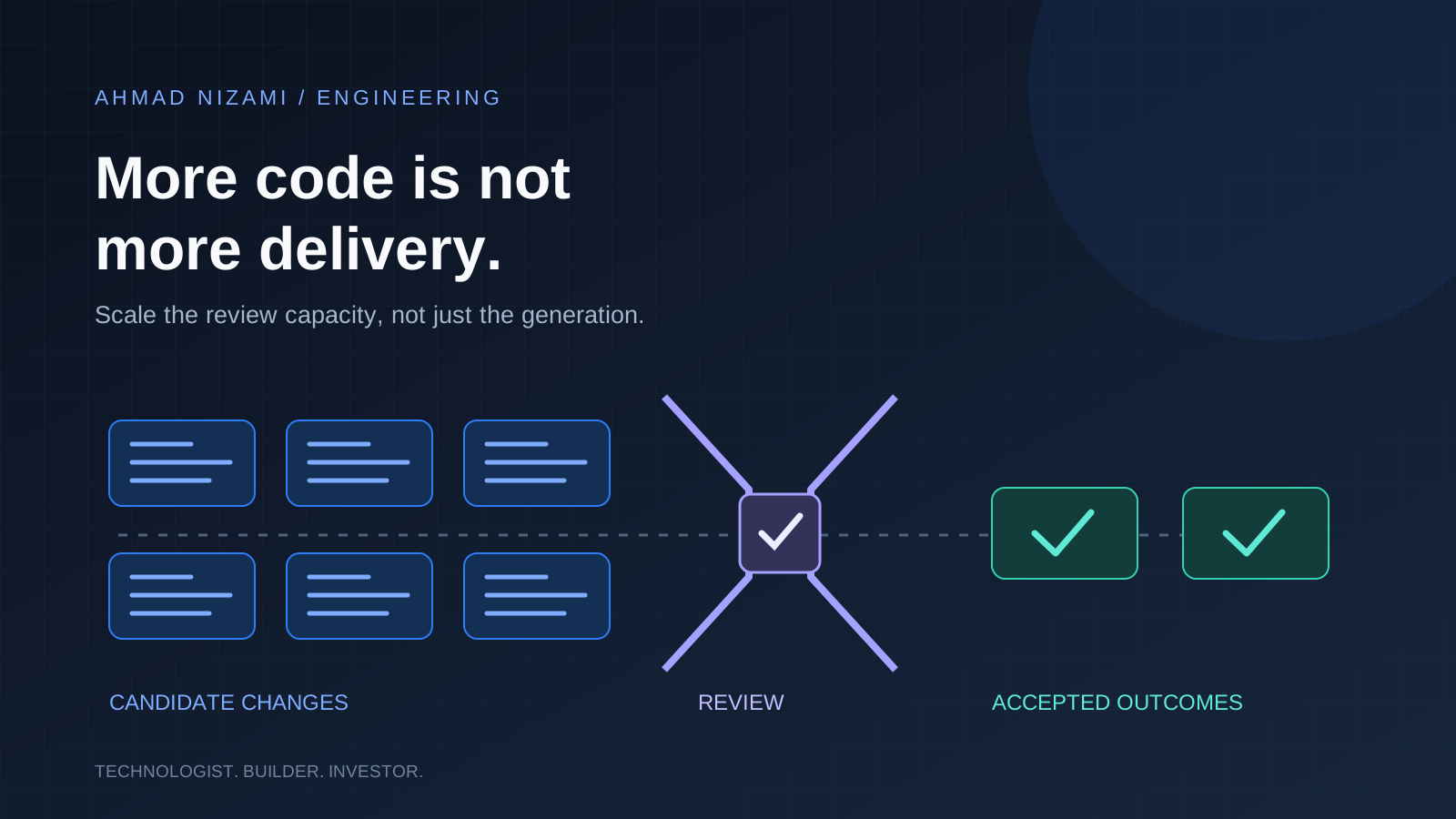
AI coding agents make it easier to produce a change. They do not automatically make it easier to accept, operate or maintain that change. For a SaaS founder or technology leader, this distinction matters more than the number of pull requests a tool can generate.
In brief: Measure AI-assisted engineering at the point where software becomes useful, not where code is written. Recent research highlights a review bottleneck, while new attribution tools promise better visibility into human and agent contributions. The practical response is to limit work in progress, improve change evidence and give reviewers real capacity.
This is a software-delivery question within the wider Agentic AI architecture and operations reading path. It is narrower than choosing an agent framework or evaluating a model. The decision here is how much agent-generated engineering work your organisation can safely absorb.
The latest evidence is about the whole production process
On 9 October 2026, Ars Technica reported research on AI coding agents and software output. The underlying paper, Artificial Intelligence in the Firm: Bottlenecks in Software Production, is by Fiona Chen and James Stratton. Its current version is dated 4 August 2026.
The researchers analyse proprietary engineering analytics from Jellyfish across 718 firms, with data running from January 2021 to March 2026. Using a staggered difference-in-differences design, they estimate increases in coding activity after firms adopt AI agents: 30% more lines of code, 20% more commits and 23% more pull requests. They do not find statistically significant increases in their measures of completed software output, based on resolved Jira issues and epics.
They also estimate a 49% increase in average pull-request review time after agent adoption. These findings are not a universal forecast for every engineering team. This is a working paper, not a peer-reviewed result, and the estimates depend on assumptions about adoption timing and comparable trajectories. Its data predates subsequent tool improvements.
Nor does a statistically insignificant output result prove that the true effect is exactly zero. What the paper challenges is the assumption that more intermediate coding activity will pass directly through to more finished software.
That is enough to change the management question. Instead of asking whether an agent writes code faster, ask which part of the delivery process becomes constrained when it does.
A queue can erase an individual productivity gain
Consider an illustrative team whose agents create candidate changes more quickly, but whose experienced engineers still have the same time for review. Every change needs someone to understand the requirement, inspect the implementation, check tests and decide whether it belongs in production.
If candidate changes arrive faster than the team can assess them, the backlog grows. A developer may finish a task earlier while the customer receives the feature later.
The delay also creates secondary work. Branches drift. Requirements change. Reviewers have to reload context. Similar fixes appear in parallel. A patch that was straightforward when written becomes awkward to merge a week later.
More reviewers can help, but only if they have the relevant expertise and time. Moving everyone into review without changing priorities simply transfers the bottleneck to planning, support or another delivery queue.
The first operating control is therefore a limit on unfinished work. Do not let an agent start another five tasks because its compute is available when the team cannot accept the changes already waiting.
This is particularly important for small SaaS businesses. One senior engineer may be the reviewer for authentication, billing, infrastructure and customer escalations. Their attention is shared capacity, not a free resource outside the AI business case.
Define an accepted change before measuring productivity
A merged pull request is not always a delivered outcome. It may be behind a feature flag, missing a migration plan, or waiting for another service. Conversely, a useful deletion or configuration correction may contain very little new code.
Use a definition of an accepted change that fits the product:
- The intended customer or operational behaviour is demonstrably correct.
- The change has passed the relevant technical and security checks.
- Deployment and reversal are understood.
- Ownership is clear after release.
- The outcome is observed in the environment where it matters.
Then measure the path to that outcome. Track elapsed time from an agreed task to accepted delivery, time waiting for review, active review effort, requested revisions, deployment failures and support consequences. Keep routine changes separate from novel architecture or high-consequence work.
This does not require a perfect analytics platform. A small team can start with a structured task template, pull-request timestamps and a weekly review of several representative changes.
The important point is consistency. If the team starts classifying tasks differently after buying a tool, its before-and-after comparison may describe a reporting change rather than a productivity improvement.
Ask the agent for evidence, not a larger explanation
A reviewer should not have to reconstruct the task from the diff. Require an evidence packet with every agent-assisted change.
It should state the problem, boundaries, relevant assumptions, files affected, tests actually run and remaining uncertainties. It should explain how the change behaves on failure and how to reverse it where reversal is possible.
For example, an agent changing a customer-service integration should identify whether retries could duplicate an action, which credentials are needed and whether a failed downstream call leaves the customer record inconsistent. A green unit test on a helper function does not answer those questions.
Keep the packet short enough to verify. A long, confident description can make weak evidence harder to see. Claims such as “all tests pass” need an actual command, result and relevant scope. A generated test that repeats the same mistaken assumption as the implementation is not independent confirmation.
The wider guide to AI agent evaluation in production explains how to assess the system rather than only its model. Here, the application is concrete: make a code change reviewable before it joins the human queue.
Attribution helps, but origin is not a risk score
On 7 October, InfoWorld covered Atlassian's Agentic Multiplayer Protocol and related visibility capabilities. The report describes vendor claims about shared context, agent identity and distinguishing human from agent contributions. It also notes that some non-human identity controls were described as coming later.
This is a useful direction, not proof that every provenance problem has been solved. Human and AI contributions are often mixed. The person whose identity appears on a commit may not be the person who authorised the task or meaningfully reviewed it.
Capture provenance where it supports an operational decision. Useful fields include the task owner, agent and model version where available, tool permissions, generated evidence and accountable reviewer. Do not use these records as a simplistic league table of engineers.
A small, well-tested agent change to an internal report may be lower risk than a human-authored change to payment settlement. Review intensity should follow consequences, novelty and evidence, not an automatic rule that all AI code needs the same treatment.
Equally, a human clicking approve is not proof of meaningful oversight. The record should make clear what was examined and who accepted responsibility for the result.
Give managers capacity, not just accountability
The bottleneck is not confined to pull requests. Managers must choose suitable tasks, resolve conflicting requirements, coach staff and deal with unexpected outcomes.
In September, Harvard Business Review argued that middle managers determine how AI adoption becomes everyday work. Earlier research by Julia Shin and Sandra J. Sucher, summarised publicly by Harvard Business School, describes additional validation and coaching responsibilities in 18 interviews at two consulting firms.
That qualitative evidence is not a measurement of engineering teams. It does, however, identify a management risk worth checking locally: assigning new oversight duties without removing old work.
For a coding-agent rollout, decide what a manager will stop doing to create review and coaching capacity. Clarify which decisions can be delegated and which need a named owner. Make it acceptable to reject a proposed automation because the task is unclear or the evidence is insufficient.
The technology delivery approach should govern the tool rollout, not the other way round. A mandate to use more AI is not a substitute for an operating plan.
Run a bounded delivery experiment
Start with one task family where outcomes are observable, such as small integration fixes with stable interfaces. Avoid combining a new agent, a major platform migration and a new team structure in the same trial.
The method for turning uncertain requirements into a delivery plan is useful here: expose assumptions and sequence the riskiest decisions before committing to a larger rollout.
Record a baseline for comparable work. Agree the definition of accepted delivery, review limits and stop conditions before introducing the agent.
During the experiment, limit concurrent candidate changes. Reserve reviewer time explicitly. Compare outcomes and rework, not only first-draft speed. Document rejected patches as well as merged ones so that unsuccessful work does not disappear from the analysis.
If review waiting time grows, reduce the arrival rate or improve the evidence before buying more generation capacity. If reviewers are repeatedly finding requirement errors, improve task scoping rather than adding another test tool.
A contact-centre platform provides a useful setting for this discipline because routing, permissions and joined-up customer context make correctness more demanding than a successful demo. The Omningage case study shows the product context, not evidence of a particular coding-agent result.
The leadership decision
AI coding agents should be scaled when they increase dependable delivery, not merely when they generate impressive activity.
Before expanding access, confirm that:
- Accepted outcomes improve for the chosen task family.
- Review waiting time and active effort remain sustainable.
- Defects and operational incidents are not being deferred into support.
- Reviewers have capacity and authority to stop weak changes.
- The economics include rework, tooling and senior attention.
If these conditions are unclear, the next investment may be better task definition, review tooling or integration tests rather than another agent licence.
For founders facing this delivery gap, discuss an engineering operating plan. The useful starting point is the team's real queue of unfinished work.
Sources and evidence notes
- Chen and Stratton, Artificial Intelligence in the Firm: Bottlenecks in Software Production, version dated 4 August 2026. Working paper using proprietary, aggregated Jellyfish data through March 2026. Estimates are not universal guarantees.
- Ars Technica, AI coding agents generate more code, but not more software, 9 October 2026. Technology reporting on the paper, not a second independent study.
- InfoWorld, Atlassian launches AMP to tackle AI code visibility, attribution, 7 October 2026. Reporting includes vendor claims and analyst assessments; future capabilities are not treated as delivered.
- HBR, Middle Managers Will Make or Break AI Adoption, Gleb Tsipursky, 1 September 2026. Management analysis, summarised rather than reproduced.
- HBR, AI Adoption Is Overloading Your Middle Managers, Julia Shin and Sandra J. Sucher, 26 June 2026, with public HBS abstract. Qualitative research in consulting, not a coding-productivity estimate.
Sources checked on 12 October 2026. The operating recommendations and illustrative examples are original analysis, not reported results from Ahmad Nizami's ventures.